
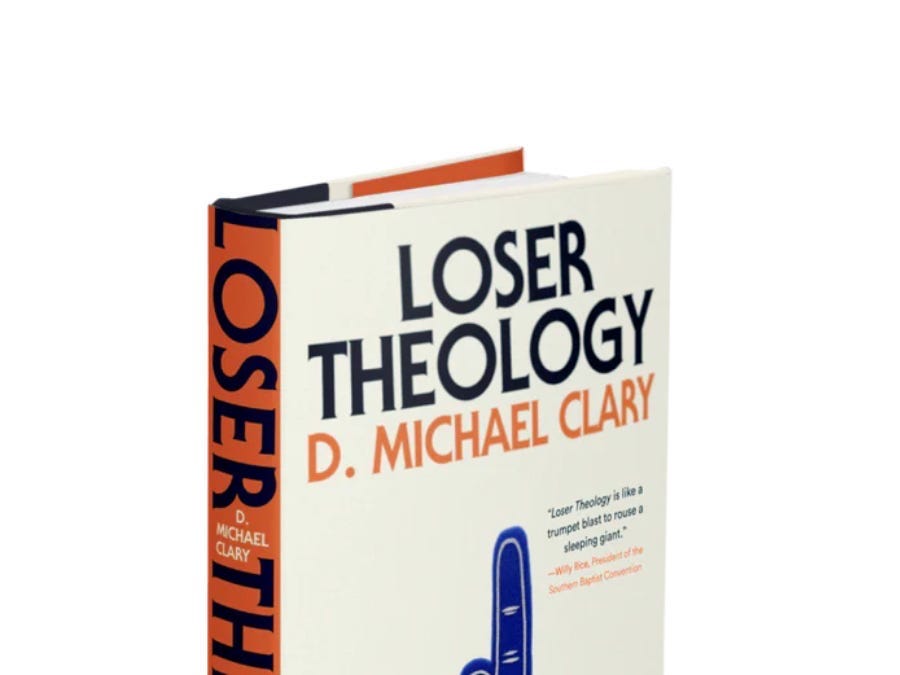
I recently finished reading a new book put out by Canon Press entitled Loser Theology, written by Pastor Michael Clary. What a title.
The name itself is pretty provocative, and some may be tempted to make a snap judgment based upon that title. Some may never read the book and therefore will miss out on just how encouraging, helpful, and insightful it is.
So what is loser theology?
First of all, let’s be clear about what it is not.
Pastor Clary is not attacking the Bible’s teaching that Christians will suffer, face persecution, or endure hardship in this life. Loser theology is not the recognition that righteous men may suffer for doing what is right. Nor is it the recognition that Christians may faithfully fight for something good and still not accomplish everything they hoped to accomplish. Faithfulness does not guarantee that every battle in this life will turn out the way we want it to.
Michael knows that. In fact, he speaks about suffering throughout the book.
Loser theology, rather, is what happens when we take those biblical teachings about suffering, weakness, persecution, and humility and twist them into a theology of passivity. It takes truths intended to strengthen Christians for faithful suffering and instead uses them to teach Christians not to strive, build, lead, exercise authority, or engage the world around them. It can shrink the Christian’s gospel witness down merely to personal evangelism and private devotion, as though faithful Christian ambition in the family, church, culture, politics, business, and the rest of life were somehow inherently suspect.
Some people fall into this unwittingly or naively. They have not studied the fullness of Scripture on these subjects and have absorbed over the years an emphasis that promotes passivity. Others push these ideas purposefully in order to keep faithful Christians from engaging cultural, political, or other areas of life so that they themselves might maintain authority and power. For some, then, loser theology grows out of immaturity. For others, it can become a naked, godless, ambitious grab for power.
Because there are different kinds of people fueling loser theology, some may be tempted to take offense at Clary’s argument because they belong much more to the first category than the second. They really do want to be faithful to what Scripture teaches about weakness, persecution, humility, and suffering. They don’t have some nefarious agenda.
Such brothers should understand that Pastor Clary is not denying any of those biblical truths. He is careful throughout the book not to accuse faithful brothers unjustly. Nor is he trying to break a bruised reed. His target is an emphasis that takes genuine biblical truths and stretches them into something Scripture itself does not teach—an outlook that demoralizes Christians, excuses passivity, and treats weakness almost as something to be pursued for its own sake.
And Michael isn’t writing about this as a man sitting above everyone else, pointing his finger at all the losers out there.
Similarly to the way Augustine confessed his own sins in his Confessions, Michael Clary is confessing his own path into loser theology and his way out of it. For many years, he believed and received many of these ideas himself. He thought that the use of authority and power was bad; that Christians are not only to boast in weakness but somehow to pursue weakness; that if you’re really faithful, you may never accomplish any of your goals, and if you are accomplishing your goals, perhaps there is something suspect about your faithfulness. In other words, success in your work, career, ministry, or other endeavors can itself begin to look suspicious, as though failure were somehow evidence of faithfulness.
That confessional character is important to the tone of the book.
One criticism someone might make is that there isn’t necessarily a clear and explicit statement of what “winning” looks like. But I don’t think the book is fundamentally contrasting winning with losing. Rather, it is contrasting teachings and emphases that create passivity among God’s people—that demoralize God’s people and make them unuseful—with a faith in Christ that produces high-agency Christians: Christians who will make use of whatever authority God gives them for good, and who will pursue with a righteous spirit good things for the glory of God and the good of the people around them.
It is a call to godly ambition.
Several years ago, I received from our sister church in Bloomington, which was then pastored by Tim Bayly, a series of lessons called David’s Mighty Men that they taught their men. One of the most helpful lessons was on godly ambition, and it was very similar to the argument Michael Clary is making here: there is such a thing as ungodly ambition.
There is an aspirational way of thinking in which men strive merely for themselves—their own glory, power, wealth, or reputation. But our temptation can then be to assume that the opposite of ungodly ambition is no ambition at all.
That is loser theology.
God calls us instead to godly ambition: an ambition to love others, to build good things, and to fight for what is right and true and good.
And so the first half of Michael Clary’s book is largely an assault on twisting Scripture’s warnings against ungodly ambition into an excuse for passivity. The second half—and perhaps even the better half of the book—is aimed at teaching godly ambition.
Michael Clary is a Baptist. He’s dealing with Baptist worlds. I grew up in a Baptist world, and I’ve run into many, many of the implications described in this book and many of the arguments he is opposing.
Some may say, “Well, this isn’t a real problem.” But Michael documents real problems, and I can personally vouch for having experienced them in many of the circles I’ve run in. You don’t have to peruse the internet for long to find these attitudes in certain Christian circles.
Michael does not define “winning” as receiving wealth and health. Neither does he teach that every Christian will conquer every obstacle, gain earthly power, or win every political battle. Winning in Loser Theology is running forth to fight the battles God calls you to fight with faith and hope, leaving the outcome in His hands.
Michael is a good Baptist in that he has a knack for creativity. Like the old Baptist preacher whose sermon points all somehow begin with the same letter, Michael gives memorable and sometimes hilarious names to the different manifestations of loser theology.
But Michael writes with clarity. And he writes with humility—not as one sitting over those struggling with these things, but as one who is himself repenting of them.
So while the title is provocative, I think most Christians will be helped and encouraged by this book—and maybe even convicted about the ways we have used certain parts of Scripture to excuse our laziness, fear, or passivity.
For me, the book encouraged me to look again to Christ, who is my Savior and who loves me, and then to give it all on the field for Him. I want to be done with self-serving ideas that merely protect my cowardice and instead have the kind of faith that makes me, as a pastor, willing to say hard things, true things, and to fight for what is good and right.
I wholeheartedly recommend Loser Theology.
This is an accurate assessment of your encouraging book, Michael. I ordered the book the day it became available on Canon Press’s website and devoured it in a couple of days. I am considering buying a copy for each of my pastors/elders. (I am a former pastor from the 90’s now serving as an elder at my church. After I left the pastorate, the Lord me back into public school teaching for the next 20 years before I retired.) Your book put into words what I have felt since 2020 when many evangelicals I trusted fell under the manipulation and deception that was endemic that year. I had wondered if the desire to be loving and graceful at the expense of truth was a lack of godly discernment or just plain cowardice (or both). You deftly diagnosed both issues.
Thank you for the labor of writing your book, and for writing it so well. (Excellence in communication is important to me.) Your words have helped fan into flame the gift of Christ in me and encouraged me to use my retirement years to fight for the Kingdom and the generations behind me. May God bless and protect you, your family, and your church, faithful brother!
And thank you, Joseph, for the excellent book review. You encapsulated well the heart and intent of the book. I am subbing your Stack today.
I will use your review to encourage others to read Michael’s book. Hopefully Michael will see my comment above and it will be an encouragement to him.